
The world, which is now one big global village, is made up of smaller communities. Communities filled with smaller groups of people, bound by similar interests or geographical location, form the world we live in today.
However, given that the world has become very connected thanks to technology and the internet, people tend to forget about their communities, especially when it comes to addressing social and political challenges.
Everyone expects that solutions made in boardrooms, top government houses, and capital cities would solve the problems and have lasting impacts.
Although the solutions can be offered in some of the above-listed places and many times, the government is in charge of providing solutions to social issues, the most impact comes when these solutions are broken into community programs and local initiatives.
Once again, the world is made of smaller communities. Your family, friends, and work group, school, or religious bodies are important parts of society where everybody feels seen and can be helped appropriately. If we want lasting changes to existing social issues, the best way to attack them is from the ground up.
Let the locals feel the solutions first, and then the impact will spread like wildfire. This is what this article is focused on. We will take a look at what local initiatives are, how they influence broader communities, and create long-lasting social impact.
Categories of Community Programs
To understand how community impact is scaled, we must first understand what they are. Local initiatives and community programs are geographically bounded, mission-driven programs designed to address specific needs within a neighborhood or city. Unlike broad governmental mandates, these programs are designed to solve a particular problem for a particular group of people. These programs typically fall into four primary categories:
Youth and Education
Community programs usually focus on youth empowerment, building skills, and educating the younger generation. After-school mentorship, coding bootcamps for local teens, and street-level literacy programs are some examples of community programs.
Economic Improvement
Some local initiatives are designed to alleviate poverty and provide immediate financial and entrepreneurial support to local businesses, which will in turn lead to economic boom and improve the lives of the community members.
Some of these initiatives include micro-loan programs for neighborhood entrepreneurs, buy local campaigns, and vocational training centers that align skills with the actual jobs available in the immediate area.
Health and Food Security
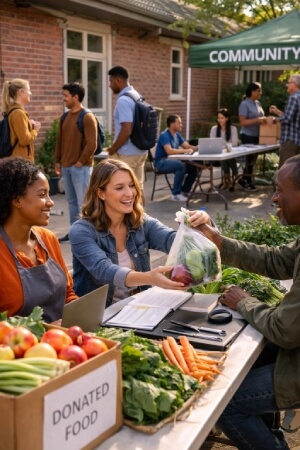
Food and health are two major elements needed for any community to survive, and many community initiatives are engineered to solve the food crisis and ensure that the well-being of locals is taken seriously.
A few initiatives designed to promote food and health security include providing community-managed fridges, urban gardens that turn vacant lots into fresh produce hubs, and neighborhood-based mental health check-in groups.
Social Connectivity
Communities and the world at large thrive on social interaction and connection. People need to feel seen and heard, and that’s why they look forward to being part of a community.
Communities where locals are free to interact and help each other develop quickly and last longer. Some of the initiatives designed to improve social connectivity include senior citizen tech-literacy workshops, neighborhood watch programs that emphasize community building over surveillance, and local festivals that celebrate the specific cultural heritage of a ZIP code.
Why Community Programs Work
Community programs work because they are close to the people and focus on solving the immediate problems of small clusters of people rather than covering overly large groups.
A policymaker in a distant capital city views a neighborhood through the lens of macro-data. All he/she sees is unemployment rates, crime statistics, or graduation percentages. While this data is useful for budgeting, it is often blind to the friction points that affect daily life.
What is a friction point, you may ask? A friction point is a specific, local barrier that prevents a broader policy from working. For example, a state-level back-to-work program might fail in a specific neighborhood not because there are no jobs, but because the local bus line stops running at 6:00 PM.
A policymaker from the capital city may look through the data and think the issue is a lack of motivation, but a local leader sees a transportation failure. Because local leaders live within the ecosystem, they can identify and work around these micro-barriers with a speed and accuracy that large bureaucracies cannot match.
Community programs also work due to a system known as Asset-Based Community Development (ABCD). Traditional social work often works using a deficit model where the work begins by asking, “What is wrong with this neighborhood? What is missing?”
This approach isn’t bad, as we need to know what’s wrong before fixing it. However, it can stigmatize a community, making residents feel like a collection of problems to be solved.
In contrast, the ABCD model flips the script by focusing on a neighborhood’s existing strengths. Instead of looking at a high population of retirees as a dependency ratio, which is a deficit, ABCD views them as a massive reservoir of experience, childcare potential, and institutional memory, making them assets to the community.
The ABCD framework prioritizes three pillars:
- Individual Skills: The unique talents of residents, from carpentry to accounting.
- Local Associations: The invisible networks, such as church groups, hobby clubs, or sports teams.
- Physical Assets: Underutilized spaces like vacant lots, school kitchens, or private gardens.
By building on what is already working, community programs create a sense of agency and ownership. When a program is built on local assets, the community isn’t just a recipient of a service; they are the architects of their own success. This internal buy-in is what ensures a program survives long after the initial grant funding or political interest has been provided.
How Community Programs Reduce Neighborhood Risks
Every neighborhood faces its own set of challenges, from housing to food and security. As these challenges persist, there is a need to find a solution, and most times, that’s where community programs come in.
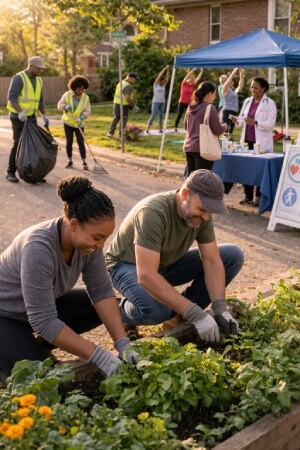
These community programs are put in place to fix these issues before they break the whole system. By targeting specific risks, these initiatives create a safer, wealthier, and healthier environment for everyone. Community programs and local initiatives reduce neighborhood risks by:
Breaking the Cycle of Financial Stress
Many people get stuck in a loop where they cannot get ahead because they lack specific skills or the small amount of cash needed to start something new.
Job-training programs and microloans (tiny, low-interest loans) act as a ladder. Instead of just providing a temporary fix, they give residents the training to land a steady career or the funds to launch a small business. This builds a local economy that is powered by the people who live there, making it much more stable over the long term.
Creating Safer Streets through Engagement
Public safety is not just about patrols; it is about what people are doing with their time and how they feel about their surroundings.
After-school programs give young people a productive, safe place to be during the hours when trouble is most likely to occur. When paired with clean and green initiatives like fixing up broken windows or planting trees, the neighborhood physically changes and feels safer and more beautiful for people to live in.
Fighting Sickness with Local Food and Movement
Health is not something that only the doctor’s office should be concerned about. Homes and schools should also be concerned because these are places where you can make contact with germs and sickness-causing elements in the first place.
To solve this, community awareness programs come into play to teach people proper hygiene and food practices. Community gardens also bring fresh, affordable vegetables to areas that usually only have access to processed snacks. When you combine that with free local fitness classes in a neighborhood park, you are tackling lifestyle diseases like diabetes or heart disease before they ever start.
Solving Problems Early
Although many community programs are reactive, they don’t always have to be. They can be proactive, solving the problem before it even happens.
Community leaders can spot problems before they happen because they live in the area and listen to their members. Community programs can go ahead to solve small problems and educate people about possible security risks or potential disease outbreaks before they even happen.
This way, you can nip a problem in the bud, just before it escalates into something beyond control.
Improving Access to Services through Community Programs
While massive government budgets are allocated to health, housing, and education, these resources are often made available in cities and are hard for many cities to reach. Even in the cities, not everyone gets access to these facilities, but community programs can bridge this gap and make it easier for residents to access these services and amenities.
Bringing these services to centers closer to the residents or creating special days where community members can get easy access to public amenities can help bridge the gap.
Sometimes, it involves listening to the community members, simplifying the process needed to get immediate help, and providing what is needed in a particular street or block to make their daily lives better.
Strengthening Support Networks Through Community Programs

Community thrives on social connectivity and interaction. People become part of a community because they want to connect with others and feel part of something bigger than themselves.
This connection is the soul of every community, and it’s what keeps them together. It is an invisible network that keeps society from breaking down even in times of stress.
To maintain this and even build further relationships within the community, especially now that everyone is becoming isolated in this digital world, local leaders promote community programs, workshops, and festivals.
Local festivals and community programs give people reasons to leave their houses and interact. Social interaction is what keeps the community alive, and these spaces are breeding grounds for new connections.
When a person feels seen by their neighbors, their mental health improves, and their personal stake in the neighborhood’s success grows. When community members are able to build strong connections over time, it helps in times of crisis.
Communities always go through one crisis or another, and sometimes, members may be dealing with personal issues. It is good to know that they can rely on their neighbor or turn to a friend in the corner who will act as a first responder in times of crisis.
Crisis tests and stretches a community’s bonds, but when the storm clears, it brings people together. Residents already know who is elderly and needs a wellness check, who has a generator to share, and how to organize local resources before official government aid even arrives.
By investing in community programs today, you’re not just funding gatherings and meetups, you are building the invisible infrastructure that saves lives tomorrow.
The Ultimate Goal of Community Programs
The ultimate goal of community programs and local programs is lasting impacts and, in some cases, generational impact.
Many policymakers, non-governmental organisations (NGOs), and support groups believe that the main goal of their work is to change the living conditions of people temporarily or sometimes, permanently.
The impact of their work is not only measured in numbers. Although it is quite impressive to see how many lives received support materials, were alleviated from poverty, and made to live better lives, the main impact is seen when this change affects the next generation and breaks the cycle.
When a local initiative helps a first-generation student graduate from college or assists a family in buying their first home, the ripple effect lasts for decades.
That student’s future children are more likely to pursue higher education, and that family’s home becomes an asset that builds intergenerational wealth. This is how we move from fixing a problem to breaking a cycle. This way, the community doesn’t always have to keep fixing the same issues year after year, and in turn, the community keeps advancing with each passing generation.
To also sustain this lasting impact, it is important to document the process, stories, and results. In a digital-first world, how a community tells its story determines its growth.
By documenting local victories and sharing them through social engines and newsletters, programs build social proof. Past, current, and future community members can always look through files, videos, and data to see the efforts put into making the community work, and how it transformed lives.
In other cases, documenting the success story of a community program can lead to visibility, which will lead to more funding and volunteer engagement, and engagement leads to even greater impact. When a community sees its own progress reflected back to it, the belief in what is possible grows, turning a small-scale initiative into a permanent cultural shift.
Building Solutions That Outlast the Problem
Community programs are mostly used to solve existing issues like the housing crisis, health, food, or security issues. Usually, these issues can be solved with policies from the government or by sticking to the government’s statewide blueprint, but community programs bring the solutions closer to the residents.
Community programs and local initiatives make residents feel seen as these initiatives take their complaints into consideration, and when the problem is solved, residents feel the impact even more.
Community programs are usually designed not just to solve immediate problems but to have a long-lasting impact. The idea is that the results of solving a crisis aren’t felt only now but in the coming months, years, and even in the next generation. Communities don’t want to keep on solving the problem; they want to solve it now and build on their success as time progresses.
The lasting impacts of community programs can also be sustained using storytelling and documentation. By documenting the process, progress, and results of a particular initiative, community leaders can preserve success stories and use them as building blocks for future stories.